

























](https://i0.wp.com/mymaharashtra.online/wp-content/uploads/2025/06/SJaishankar.jpg?resize=360%2C180&ssl=1)
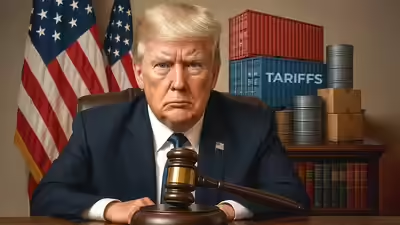
1. Donald Trump Reciprocal Tariffs Supreme Court Case Overview
Donald Trump Reciprocal Tariffs Supreme Court hearing marks one of the most crucial tests of presidential power in modern US history.
The Supreme Court has raised serious doubts about the legality of Trump’s reciprocal tariffs, which have defined his economic and diplomatic strategy since returning to office.
The case could determine whether the President of the United States can unilaterally impose tariffs on foreign countries without Congressional approval — a ruling that may reshape both US trade law and the global economy.
2. Why the Reciprocal Tariffs Matter
Trump’s reciprocal tariffs were designed to match foreign import taxes on American goods.
His administration argues that this approach protects domestic industries and ensures “fair trade.”
Since 2024, these tariffs have generated nearly $90 billion in federal revenue, almost half of all US tariff income.
Critics, however, argue that these policies have fueled trade wars, raised consumer prices, and strained diplomatic relations with countries like China, Germany, and Canada.
3. Key Highlights from the Supreme Court Hearing
The Donald Trump Reciprocal Tariffs Supreme Court hearing lasted nearly three hours.
Justices from both conservative and liberal wings expressed skepticism about Trump’s authority under the International Emergency Economic Powers Act (IEEPA) of 1977.
Chief Justice John Roberts observed that “taxation has always been a Congressional power,” while Justice Amy Coney Barrett questioned the broad application of the law.
Justice Neil Gorsuch warned against giving presidents “unlimited control” over trade.
4. Legal Debate: Can a President Impose Tariffs?
The Donald Trump Reciprocal Tariffs Supreme Court case centers on a constitutional question — can the President act independently of Congress in economic emergencies?
Lower courts ruled that Trump overstepped his authority, citing the absence of historical precedent for using IEEPA to justify tariffs.
The Supreme Court’s review will now set a new benchmark for executive versus legislative power in trade policy.
5. Economic and Political Stakes for the US
The stakes are immense.
If the Donald Trump Reciprocal Tariffs Supreme Court ruling goes against the President, the government may have to refund portions of the $90 billion collected — a decision that could disrupt financial markets and global trade agreements.
Economists warn the outcome could redefine US trade policy and limit presidential flexibility for decades.
Trump’s supporters view the tariffs as essential for protecting American jobs, while opponents call them economically damaging populism.
6. Trump’s Response and Social Media Buzz
Reacting to the hearings, Donald Trump called the case “devastating for America if lost.”
He warned that striking down his tariffs could cripple manufacturing and “hand economic advantage to foreign powers.”
Social media is flooded with heated debate.
Prediction platforms currently give Trump’s side a 30% chance of success after justices expressed strong skepticism.
7. What Happens Next in the Supreme Court?
The Donald Trump Reciprocal Tariffs Supreme Court verdict is expected within weeks due to the case’s global significance.
If Trump loses, it will curtail the executive branch’s ability to unilaterally control trade and taxation.
Reports suggest the White House is already drafting alternative trade mechanisms to preserve parts of the policy if struck down.
8. Conclusion
The Donald Trump Reciprocal Tariffs Supreme Court case isn’t just about trade — it’s about the limits of presidential power in the modern era.
A ruling against Trump could reshape economic governance, US foreign relations, and the legal boundaries of executive authority for decades to come.
Whether upheld or overturned, this decision will echo across global markets and redefine how America conducts trade diplomacy.